
Hella De Santarossa - Je ne regrette rien
September 4 to October 24, 2026
Opening on Thursday, September 3 at 7 pm. Introduction by Heinz-Norbert Jocks, Curator, Author and Correspondent for Kunstforum International
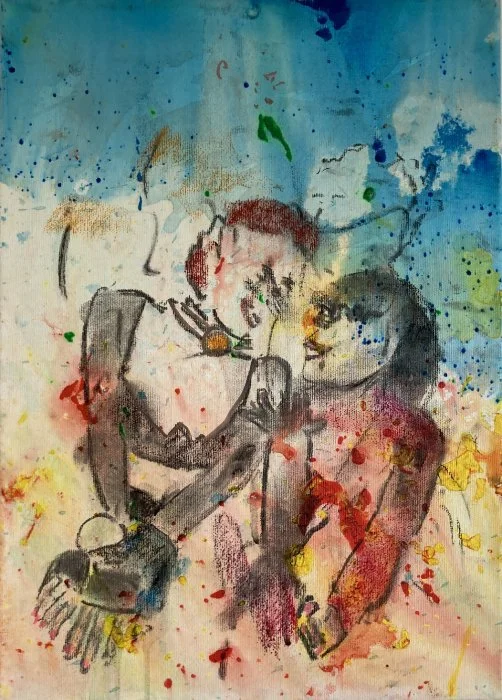
Tanz auf dem Glatteis, Mixed media on canvas, 2025
Beyond the Wild
Hella De Santarossa: Between Painting, Glass and Movement
An essay by Heinz-Norbert Jocks
The ‘Jungen Wilde’, once in the headlines and described by Wolfgang Max Faust as having a ‘hunger for images’, were less a clearly defined group of artists than a cry for a new beginning. In the early 1980s, something that had long lain beneath the surface seemed to burst forth in West-German art, linked to a passion for colour, form, the body, narrative and spontaneous gesture. Following the restrictive years of Conceptual and Minimal Art, a young generation took up the brush once more. In Berlin, Rainer Fetting, Helmut Middendorf, Salomé and Bernd Zimmer were the best-known figures. They were joined by artists from other cities and scenes. The term ‘Neue Wilde’ was coined in 1980 by Wolfgang Becker for the exhibition Les nouveaux Fauves – Die Neuen Wilden in Aachen and became a hallmark.
Wolfgang Max Faust, in turn, described the new situation in his 1982 book *Hunger nach Bildern. German Contemporary Painting, published in 1982 in collaboration with Gerd de Vries, described the new situation as a radical reorientation of art. The term struck a chord: painting wanted to be seen again and to be visible.
Today, the buzz of that time has largely died down. The brief celebrity cult of the early 1980s, which saw gallery owners buying up entire studios and propelling artists into the international spotlight within a matter of months, is history. The movement itself lost momentum after a few turbulent years. Only a few artists remained in the spotlight; others faded from view. This makes it all the more interesting to look at those artists who, whilst at the heart of this movement at the time, did not later become fully absorbed into its narrative. One such artist is Hella De Santarossa. Born in Düsseldorf-Kaiserswerth in 1949, she came from a world in which art existed not merely as an abstract idea, but as craftsmanship, material and daily labour. Her father, Wilhelm Derix, died shortly after her birth. Her mother continued to run the family business, Derix, as the third generation at the helm. Santarossa trained as a state-certified glass painter at the Hadamar School of Glass and graduated with distinction in 1969.
In 1973 she moved to Berlin and studied fine art painting at the Berlin University of the Arts under Karl Horst Hödicke until 1979, becoming his star pupil.
Glass in her blood
This already laid the foundations for something that would prove decisive for her later work: Santarossa did not come to painting through painting alone. Glass was part of her artistic practice from the very beginning.
“Glass was in my blood from the very start,” she says in an interview. Elsewhere, she puts it succinctly: “Sky and glass, transparency.” At first, this sounds almost like a casual association. But when one considers her work over the decades, it becomes a key. For her, glass is not a side project alongside painting, but a space for thought and perception that feeds back into her painting. Transparency, light, superimposition, permeability, reflection, a film of colour and the experience of materiality define the image even where no glass is visible at all.Her painting therefore often seems to be based less on a solid surface than on layers through which something shines through. The paint is not merely applied; it settles. Backgrounds become atmospheric spaces; figures appear as if set within them, detached from them, or pushed forth from a layer of paint. In conversation with the author, she describes her working process accordingly as a multi-stage procedure. First, a base is created from several layers of paint. She allows it to dry, sometimes for days. Only then does she draw or paint the figures into it. For her, the so-called background is not merely a backdrop. ‘With the “background”, I try to capture the mood in which the figures move,’ she says. The figure therefore does not enter a space that is already complete. It emerges from a space that is already emotionally charged. It is precisely here that the stained-glass artist’s experience comes to the fore. This experience compels her to conceive of colour differently – namely as a carrier of light, as a layer, and as a transition between the interior and the exterior. The picture is never merely an opaque surface.
It can glow, shine through, and change in response to its surroundings. Santarossa’s painting seems to have absorbed this experience. Her canvases, too, often appear like membranes that store something rather than merely depicting it. Perhaps this also explains her peculiar assertion that her paintings are more ‘Impressionist’ than Expressionist. In conversation, she corrects the expected view of the ‘wild’ with the words: ‘I’ve always said that my paintings are Impressionist rather than Expressionist.’ When asked what she means by this, she initially replies, almost at a loss: ‘I don’t know either.’ Then she finds the key term: ‘On the one hand, the impressions.’ She works from impressions, from what she sees and what she captures. She does not simply copy the world; she translates it into a different form through memory, movement, atmosphere and material.
A suitcase full of photos
Even as a child, Santarossa developed her father’s photographs herself. She was fascinated by the technical side of the medium just as much as by the act of observation. Later, photography became a source of inspiration for her painting. She photographs movements, situations and people, and collects them. “I have suitcases full of photos,” she says. What appeals to her is the moment just before it turns into a memory. Painting thus becomes a second form of remembrance.
‘For me, movement equals time,’ is how she sums it up. This essence could serve as an epigraph to much of her work. For her, movement is not merely a motif, but a method. She photographs movement, films it, paints it, and translates it into glass and performance. In this context, the line can appear like the trail of a body, and the colour like an afterimage. A body does not remain in one place, but seems to contain several moments simultaneously. This is exemplified in early works such as Mechanischer Körper. Santarossa, who describes the movement there as choppy, refers to a film whose sequences of movement she has repeated in her paintings. The figure does not appear as a static body, but as a sequence of states of movement. In this respect, the work is in the spirit of that era in which Berlin painting placed the body, sexuality, nightlife and urban energy at the centre. But Santarossa turns this into something of her own: the figure becomes not merely a vehicle of expression, but a body of time. ‘I dance my way into my paintings!’ she says herself. In doing so, she describes her painting not merely as a depiction of movement, but as a process intrinsically linked to movement. It is also striking that she painted an unusually large number of men in the 1980s.
For her, this was a protest against male dominance in the art world. ‘Why should I always paint women?’, she asked, answering her own question with a series of paintings of men exhibited at the Künstlerhaus Bethanien and the Philharmonie, including sexual and orgiasticscenes, some painted with tar. This ties in with another of her experiences: with Mount Etna and the sensual yet dangerous materiality of the black, glossy substance. She recounts that she later even found the smell of tar addictive and eventually realised just how dangerous the material was. Here, too, we see an artist who experiences her materials physically. The narrative of the Neue Wilde was male-dominated. Santarossa herself puts it in stark terms: “It was a Berlin macho scene.” And even more pointedly: “I find them too macho and conceited.” Her involvement in the scene is therefore not simply a story of belonging, but also a story of self-assertion.
In the circle of Karl Horst Hödicke
Santarossa was part of Karl Horst Hödicke’s circle and describes Salomé, Middendorf and Fetting as artists with whom she was associated at the time. She even made a film together with Fetting. She was already working with Super 8 films whilst still a student; her films were screened at the Yorck cinema. She was therefore not merely a painter within a painting scene, but moved between media from the very beginning. It is precisely for this reason that the conventional portrayal of the Neue Wilde is too narrow for Santarossa. She herself recounts that she travelled extensively in the 1980s: to America, Florence, Rome, Olevano Romano, and later to Brazil and other places. She received grants, including the Annette Kade Grant, a DAAD grant, the Karl Schmidt-Rottluff Grant and a grant from the Villa Massimo. In 1984, she travelled to Brazil with the support of the Schmidt-Rottluff Foundation. Consequently, at the very moment when the image of the Neue Wilde was taking shape internationally, she was often not present where this narrative was being formed. In 1982, her work was shown as part of the supporting programme for documenta 7. At the same time, she was travelling abroad.
Her absence later became almost a paradoxical factor in how her work was received. At the time of documenta, she was not in Germany. “That’s how Elvira Bach made her name,” she suggests. This is not meant pejoratively, but rather as an observation that visibility in art history is also shaped by presence, networks and occupying the right position at the right moment.
Today, when discussing female artists associated with the Neue Wilde movement, Elvira Bach and Ina Barfuß are the names most frequently mentioned. Elvira Bach has long since established herself as a distinct and recognised figure. As part of the Berlin art scene, she achieved international recognition. Ina Barfuß, who also belonged to the Berlin art scene of those years, is, by contrast, significantly less prominent today. In retrospect, however, Santarossa is often mentioned only in passing.
It is precisely for this reason that the current exhibition of her works from the 1980s, alongside new works from 2025/26, is more than just a rediscovery: it is a shift in perspective. The aim here should not be simply to retrospectively label Santarossa as a ‘female Neue Wilde’. That would be replacing one label with another. What is more interesting is what happens when one considers her work beyond the confines of the group’s label. Then her painting appears not as an isolated part of a neo-expressionist movement, but as a nexus of glass, photography, film, performance, travel, music, politics and movement. Brazil, mon amourBrazil marked a decisive turning point in this regard. Santarossa recounts experiences of samba, capoeira, music, Catholic rituals and encounters with Afro-Brazilian traditions. These experiences gave rise, amongst other things, to the series Siedender Samba and *Heiße Erde*. The exhibition Terra Quente at the museum FLUXUS+ in 2026 showcased eight large-format works from this context and highlighted just how profoundly her experience in Brazil shaped her art of the 1980s. The museum explains that in 1984, with the support of the Schmidt-Rottluff Foundation, Santarossa travelled through Brazil, where, amongst other things, she gave lectures, took part in symposia and produced the series Siedender Samba.
The cycle Heiße Erde followed during a subsequent stay. In Heiße Erde, bodies, ritual and colour converge. The figures do not appear to be standing on a neutral stage. The space itself is in motion. Red, brown and dark shades create a heat that can almost be physically felt. Santarossa speaks of the indigenous peoples, the enslaved, and the way their religious traditions were overlaid by Catholicism.
Here, the political does not appear as a slogan, but as a layering of history. In this, too, lies a connection to glass. Glass can overlay without completely obscuring. One colour can remain visible through another. History functions similarly in her images: one layer does not completely erase the previous one. Rather, it alters its visibility. This is clearly evident in her later cityscapes. After the fall of the Wall, her focus shifted. ‘With the fall of the Wall, I took a new direction,’ she says. She worked on the Wall, on Berlin, and later on Moscow and Paris. The focus was no longer solely on individual people, but on cities, squares, monuments and transitional spaces. Her 1996 exhibition Transit-Station in the Orangery of Charlottenburg Palace dealt with such transitional spaces. The concept of ‘transit’ is central to Santarossa’s entire body of work. Nothing ever remains entirely in its place in her work.
Painting flows into glass, glass into architecture, architecture into public space, photography into painting, and movement into film. Even the city itself becomes a medium for images.
Glass and Movement
The most famous expression of this approach is the Blue Obelisk on Theodor-Heuss-Platz. Santarossa won the competition to design the square in 1987. The 15-metre-high fountain sculpture, made of hand-blown blue antique glass, was completed in 1995 and consists of seven glass blocks of varying sizes stacked on top of one another. Handwritten texts on the glass recount the history of the site and fragments of the present day.
Santarossa reports that she avoided working with glass from 1978 to 1997. For the Blue Obelisk, however, she spent eight years on preparatory work, particularly on the specialised technique required for its realisation.
In connection with the Church of the Holy Spirit, she states that she won an international competition in 1997 and, in the process, developed a new technique which has been patented. These details are reproduced here as her own statements. In conversation with the author, she speaks of the years of development required to realise her vision technically. She wanted open edges, even though she had initially been told that this was not possible. It is precisely this tenacity that is characteristic: the material is not subordinated to technical possibilities, but rather the technique must yield to the artistic idea. The Blue Obelisk is therefore not simply a large glass sculpture . It demonstrates what Santarossa means by ‘Cross-Art’: architecture, history, writing, water, light, colour and the public sphere come together. The site is not merely decorated, but tells a story; the city itself becomes the material. Once again, this work leads back to painting. Anyone familiar with her paintings will suddenly recognise something of the obelisk in them: the delight in transparent spaces of colour, in layering, in luminoussurfaces and in the relationship between line and ground. Glass has not supplanted painting, but rather altered her perspective on it. ‘Hand-blown glass has a wonderful luminosity,’ says Santarossa. This is perhaps one of her most succinct statements about the material. For her, luminosity does not merely mean brightness, but that colour generates a space of its own accord. Her canvases can be read like glass paintings, which create their transparency not through technical means but through painting.
The Fall of the Wall and the City
After the fall of the Wall, her focus shifted. “The fall of the Wall marked a turning point for me,” she says. She worked on the Wall, on Berlin, and later on Moscow and Paris. The focus was no longer solely on individual people, but on cities, squares, monuments and transitional spaces. In this context, she mentions ‘Mauer Adé’, a work featuring images, photographs and films at the Gendarmenmarkt in the large Lafayette-Haus. Her details list the years ‘1919–2020’; as this dating is ambiguous in the information provided, it is not adopted here as a confirmed date.
Santarossa also reports that her voice could be heard throughout Berlin via the Kulturwerk Berlin whilst she was speaking about the fall of the Wall. According to her own account, her most recent major solo exhibition, ‘Green Deal’, took place at the European Academy in 2022. She states that this work, or rather this exhibition, can also be viewed on YouTube.
Painting to Music
Her later nature paintings can also be viewed in a new light from this perspective. She recounts how she would take primed canvases outside, sit amidst nature and paint poppies, dandelions or other motifs there, and speaks of finding nothing more beautiful than ‘looking through the leaves’. Once again, the focus is on vistas, light and atmosphere. Nature is not a backdrop, but a space of perception. Music plays a similar role to glass in this context.
Santarossa played the violin as a child and later worked with rock music. Her paintings often emerge with an inner or actual soundtrack. ‘Essentially, the paintings are always painted with music in mind,’ she says. For her, movement, sound and colour belong together. Seen in this light, Santarossa is perhaps less a painter of wild gestures than a translator who transposes movement into line, music into colour, memory into image, journey into atmosphere, history into glass and politics into symbols.
Her art thrives on transitions. This also explains her affinity with the Neue Wilde and, at the same time, her distance from them. She shares with them a return to the figure, a love of colour, expressive gesture and a rejection of a purely academic conception of art. But she does not confine herself to the canvas. Whilst the movement increasingly defined itself through painting, her path repeatedly leads her beyond it. Her own models are by no means merely interchangeable bodies. They are people from her immediate circle— ,including dancers, characters from performances, people she observed whilst travelling, women from Brazil’s nightlife and men whom she deliberately painted as counter-images to the usual female models. The unposed moment is particularly important to her. When taking photographs, she wants to capture people in motion before they strike a pose for the camera. “I don’t like it when they just stand there,” she says. The image should come from life, notfrom a pose. This brings us full circle to her statement: “I love life!” It is not mere decorative optimism. In her work, this statement represents a method. She collects, observes, photographs, films, paints, travels, recalls and captures what would otherwise be in danger of disappearing. Perhaps that is also why her pictures hold an almost personal significance for her. “The pictures are like my children. I have thousands of children.” For her, a work is not a finished product, but a piece of lived time.
Beyond the Neue Wilde, Hella De Santarossa therefore does not appear as a belated representative of a bygone movement, but as an artist whose work eludes such simplistic labelling. Whilst her story begins at the very dawn of the Berlin School of Painting, it continues to evolve: from the body to space, from the picture to glass, from the Wall to the city, from Brazil to memory, from film to movement, and time and again back to painting.
The exhibition Hella De Santarossa – Je ne regrette rien at the C&B Reichert Gallery in Berlin, which brings together works from the 1980s with new works from 2025/26, takes its starting point precisely here. It presents not merely an artist from the history of the ‘Junge Wilde’, but a creative stance that has continued to evolve over the decades. And perhaps therein lies the real point of her rediscovery. The question is no longer why Hella De Santarossa stood in the shadow of the familiar narrative back then. What is more interesting is what that narrative itself overlooked. The era of the Neue Wilde was loud, fast-paced and masculine; Santarossa’s work, by contrast, was more permeable from the outset: across media, countries, materials and genders; between private memory and public history. She herself has a simple way of putting it: ‘I dance the images. For me, movement is simply everything.’ Perhaps this is the most apt description of an artist who never quite blended into a group and preferred to follow her own path.
Sources: Hella De Santarossa, conversation with Heinz-Norbert Jocks, unpublished interview; Wolfgang Max Faust/Gerd de Vries, Hunger nach Bildern. Contemporary German Painting, Cologne 1982; Hella De Santarossa, The Wild Instinct and Papal Court Glass Painting; museum FLUXUS+, materials on Hella De Santarossa and TERRA QUENTE, 2026; ‘Sculpture in Berlin’ and Berlin.de on the Blue Obelisk.